
.svg)

The Western Canada Hydrogen Corridors Initiative (WCHCI) is a plan to decarbonize long-haul trucking while strengthening Canada’s industrial competitiveness, energy security and economy.
Contact the Initiative TeamAnalysis and engagement phases
Geographic Scope
Heavy-duty freight focus
Technology assessment

The WCHCI is designed to support informed decision-making and reduce uncertainty around hydrogen-powered heavy-duty freight deployment by addressing both hydrogen supply and demand together. Through a multi-stakeholder consortium of fleet operators, vehicle manufacturers, hydrogen producers, and distributors, the initiative helps clarify the conditions needed to scale demand, unlock infrastructure investment, and reduce costs over time.
Addresses hydrogen supply and demand together by assessing vehicles, fueling infrastructure, operations, workforce readiness, and supporting services needed for reliable heavy-duty freight deployment.
Focuses on de-risking hydrogen operations, safety, supply, and performance by using pilot-at-scale planning to support longer-term adoption, deployment, and commercialization, as infrastructure expands and production scales.
Examines deployment arrangements and commercial models, including options such as pay-per-use and vehicle leasing, to help lower total cost of ownership and support viable fleet transition pathways. Compare the total cost of ownership of heavy-duty trucks using our TCO Calculator.
Provides insights from pilot-at-scale planning to inform public investment, infrastructure planning, and policy alignment that accelerate decarbonization while strengthening energy security and economic competitiveness.
Supports the Edmonton region and Western Canada’s role as a leader in clean freight and hydrogen innovation, building on existing expertise, resources, and a supportive ecosystem.
Demonstrates how hydrogen mobility works alongside electrification to enable broader, faster decarbonization, support system resilience, and relieve pressure on the electric grid during scale-up.
Addresses the supply-and-demand coordination challenge by convening fleets, manufacturers, producers, and distributors to support infrastructure investment and long-term market viability.
Helps de-risk investment in hydrogen production, transportation, and infrastructure by applying pilot-at-scale analysis to system-level deployment planning.
Supports job creation, sustainable infrastructure development, and broader economic benefits in Western Canada, with a focus on inclusive participation, including Indigenous engagement.
Priority and secondary routes were identified using a structured, data-informed approach that considers truck freight activity, proximity to hydrogen supply, availability of refuelling infrastructure, and access to maintenance and service support. Together, these routes represent practical conditions for piloting hydrogen-powered heavy-duty freight operations in Western Canada.
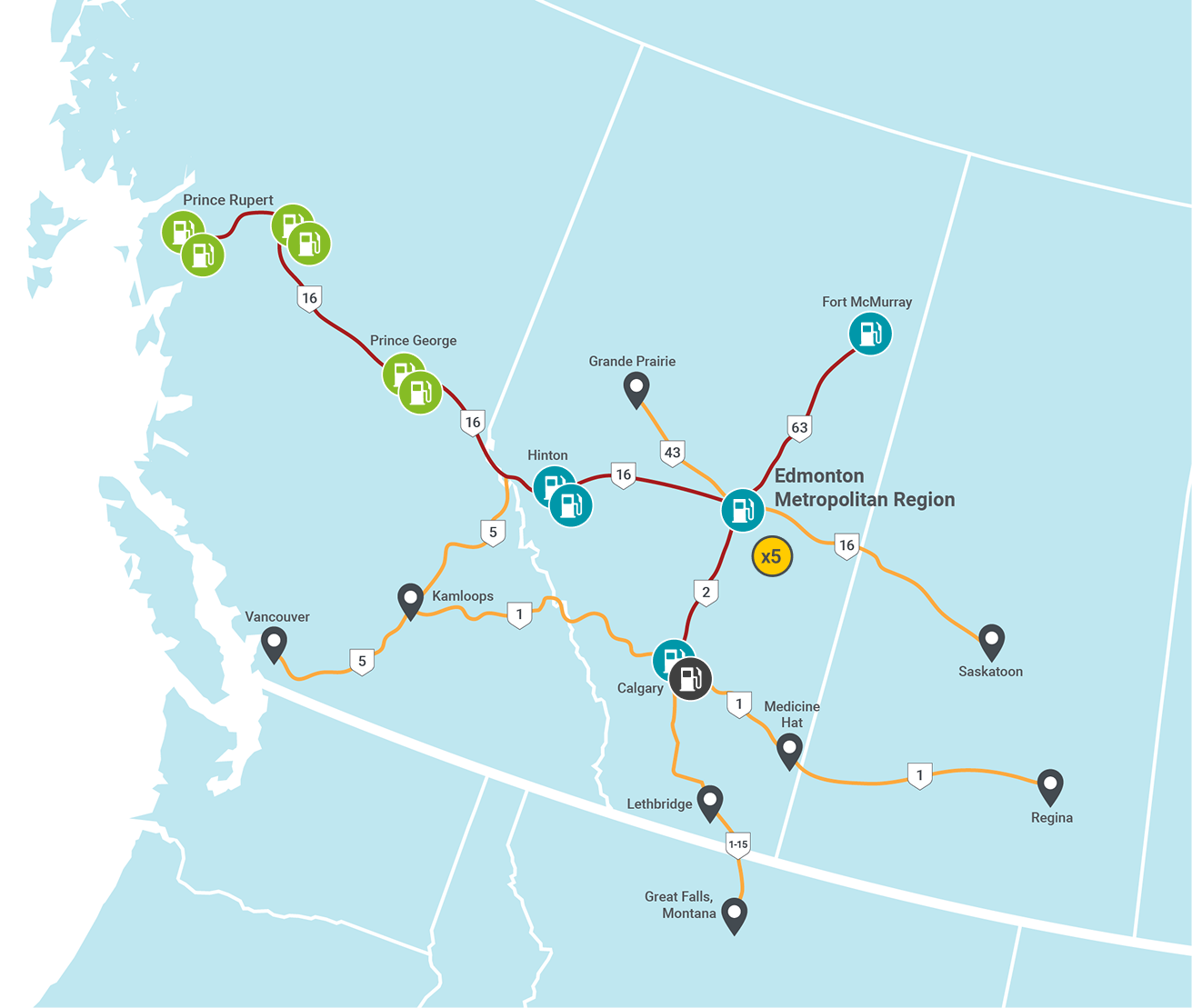
Proposed refuelling locations illustrate potential hydrogen supply pathways that could support pilot activities along selected routes. Production methods shown are indicative only and do not prescribe final configurations, which will be determined in consultation with partners.

Refuelling station with hydrogen produced via electrolysis

Refuelling station with hydrogen produced via ATR + CCUS

Hydrogen refuelling station supplied by ATR + CCUS and partial methane pyrolysis
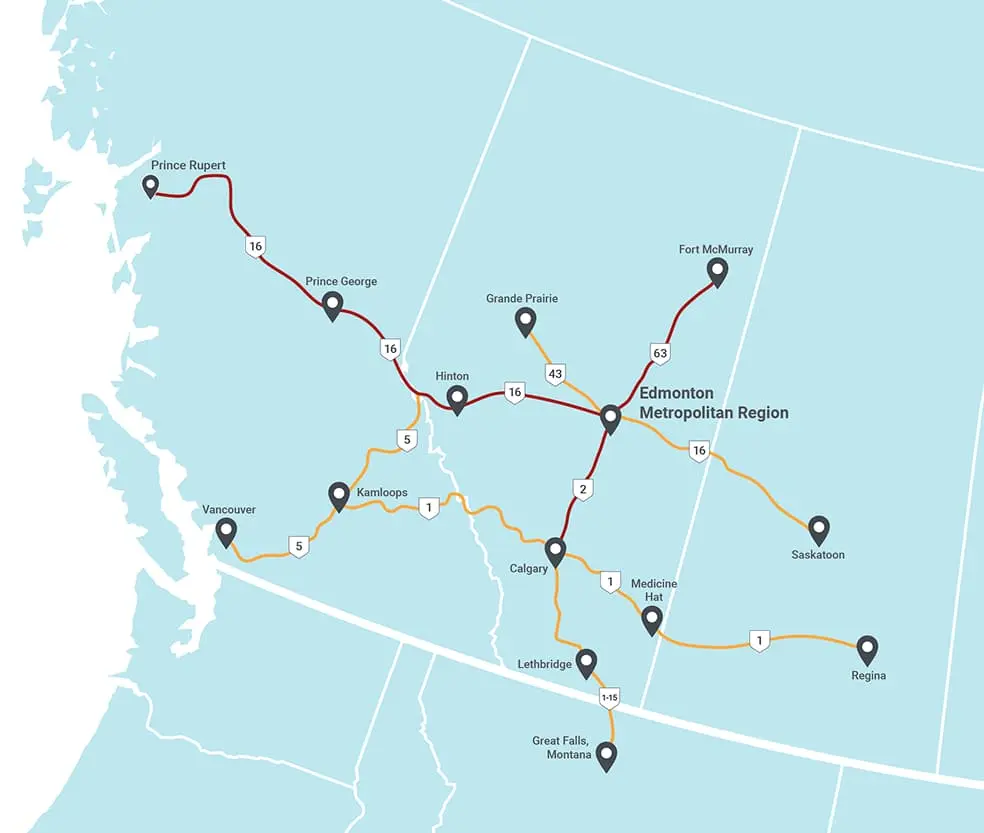


Priority and secondary routes were identified using a structured, data-informed approach that considers truck freight activity, proximity to hydrogen supply, availability of refuelling infrastructure, and access to maintenance and service support. Together, these routes represent practical conditions for piloting hydrogen-powered heavy-duty freight operations in Western Canada.


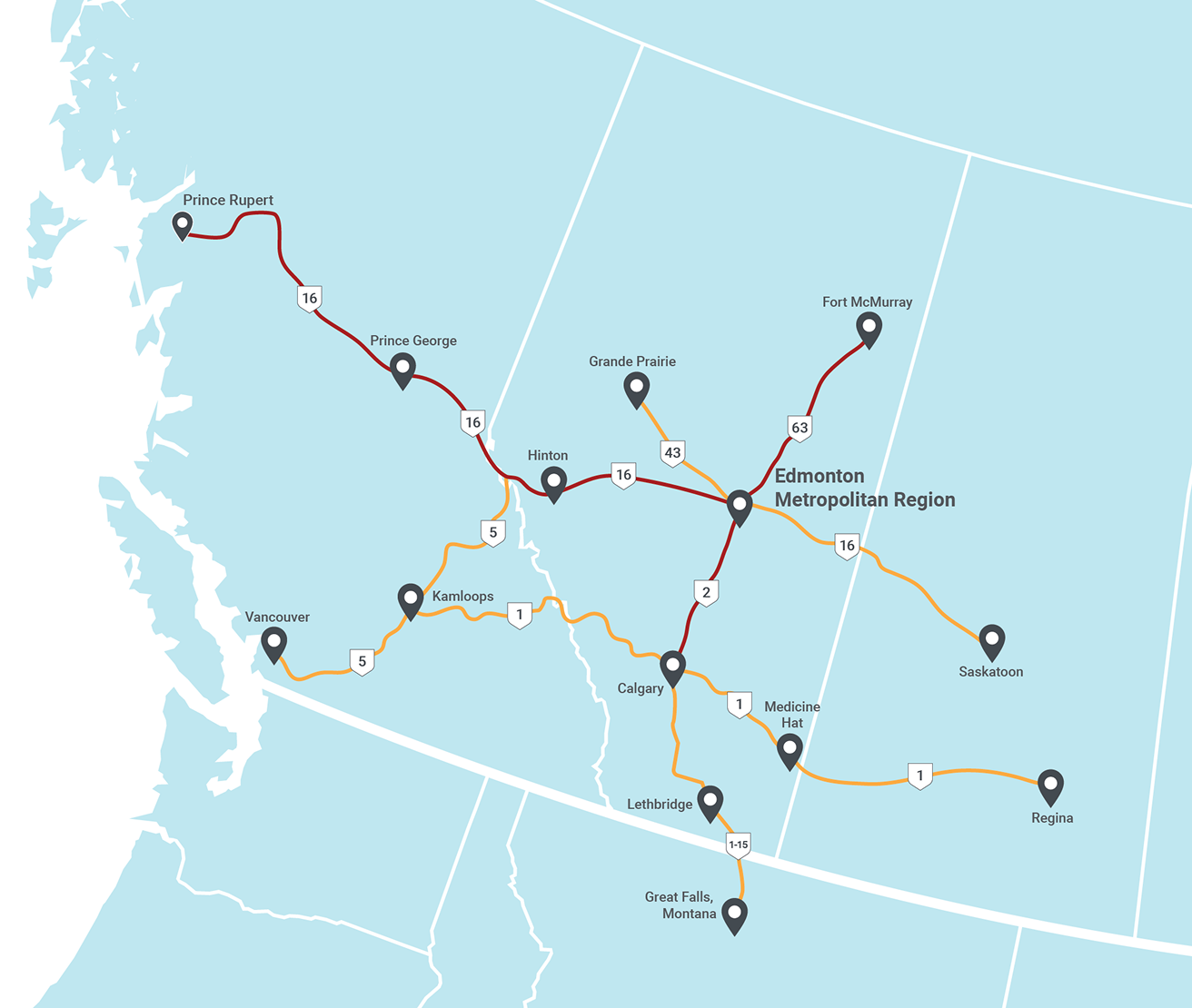
Proposed refuelling locations illustrate potential hydrogen supply pathways that could support pilot activities along selected routes. Production methods shown are indicative only and do not prescribe final configurations, which will be determined in consultation with partners.
Refuelling station with hydrogen produced via electrolysis
Refuelling station with hydrogen produced via ATR + CCUS
Hydrogen refuelling station supplied by ATR + CCUS and partial methane pyrolysis
Pilot at scale is a planning and evaluation approach used to assess hydrogen-powered heavy-duty freight deployment under real-world conditions. It examines operations, safety, hydrogen supply, demand, policy alignment, and system economics together to reduce risk and inform readiness ahead of broader adoption and commercialization.
Engagements included demand-side fleets, hydrogen supply partners, OEMs, and enabling organizations.
organizations approached
stakeholder interviews completed
As part of pilot-at-scale planning, multiple commercial structures were examined to understand how participation, investment, and risk could be aligned across stakeholders.

Shared investment and risk between public and private participants to support infrastructure and deployment.

Usage-based structures designed to reduce upfront costs and support early-stage fleet participation.

Vehicle or infrastructure leasing arrangements to lower capital barriers and increase deployment flexibility.

Strong alignment with the initiative’s phased approach
Corridor development viewed as critical
Broad interest across the value chain
Financial support contingent on clarity


Pilot at scale is a planning and evaluation approach used to assess hydrogen-powered heavy-duty freight deployment under real-world conditions. It examines operations, safety, hydrogen supply, demand, policy alignment, and system economics together to reduce risk and inform readiness ahead of broader adoption and commercialization.
As part of pilot-at-scale planning, multiple commercial structures were examined to understand how participation, investment, and risk could be aligned across stakeholders.
Engagements included demand-side fleets, hydrogen supply partners, OEMs, and enabling organizations.
Usage-based structures designed to reduce upfront costs and support early-stage fleet participation.
Engagements included demVehicle or infrastructure leasing arrangements to lower capital barriers and increase deployment flexibility.and-side fleets, hydrogen supply partners, OEMs, and enabling organizations.
Strong alignment with the initiative’s phased approach
Corridor development viewed as critical
Broad interest across the value chain
Financial support contingent on clarity
The initiative is advancing through a phased, collaborative process informed by analysis, stakeholder engagement, and pilot-at-scale planning. Detailed findings, modelling assumptions, corridor analyses, and supporting materials are available through a full Project Overview Report.
To request access, learn more about the initiative, or discuss opportunities to get involved, please contact the project team.














Edmonton Region Hydrogen Hub is located and operates in Amiskwaciwâskahikan on Treaty 6 Territory and Métis homelands.
We acknowledge this land as the traditional gathering place and centre for trade for many Indigenous peoples, including First Nations, Métis, and Inuit. We recognize that inclusivity is at the heart of sustainable growth and understand that Indigenous partnerships and voices must be at the forefront of the radical transformation of our region